AHK-Cu vs GHK-Cu: comparing two copper tripeptides
AHK-Cu and GHK-Cu are copper(II) complexes of closely related tripeptides. They differ by one amino acid, which makes them a useful pair for structure–activity work in cell models.
Side by side
| GHK-Cu | AHK-Cu | |
|---|---|---|
| Sequence | Gly-His-Lys | Ala-His-Lys |
| Free peptide | C14H24N6O4, 340.4 g/mol | C15H26N6O4, 354.4 g/mol |
| Copper complex | ≈ 401.9 g/mol | ≈ 415.9 g/mol |
| Origin | Isolated from human plasma (1973) | Synthetic analog |
| Literature | Large: in vitro, animal, reviews | Smaller: mainly cell culture |
The one-residue difference
Both peptides keep the His-Lys motif and bind copper(II) through the N-terminal amino group, the adjacent amide nitrogen and the histidine imidazole. Replacing glycine with alanine adds a methyl side chain at the N-terminus, which changes the molecule’s size and hydrophobicity slightly. Comparing the two helps separate effects of the copper-binding motif from effects of the N-terminal residue.
Published research on AHK-Cu
- A tripeptide-copper complex was studied for its effect on cultured human hair follicles (Pyo et al., Arch. Pharm. Res., 2007).
- AHK and dimeric AHK derivatives were evaluated for proliferation of primary human dermal papilla cells in culture (Jeong, Park & Kim, Bull. Korean Chem. Soc., 2021).
For the much larger GHK-Cu literature, see our GHK-Cu research overview.
Verifying either compound
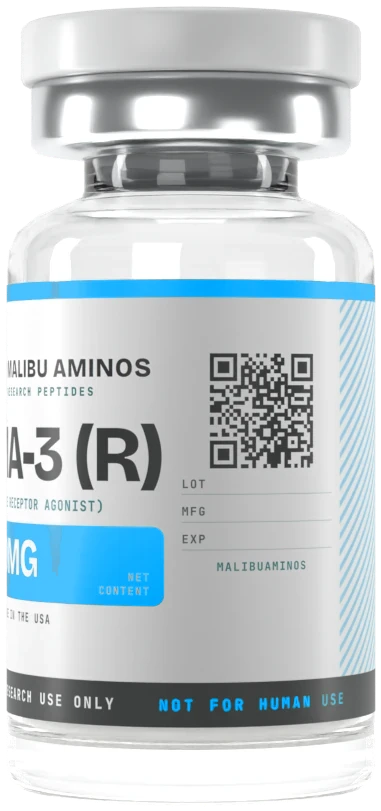
Because the two differ by only 14 mass units (one CH2 group), mass spectrometry is the clearest way to confirm which peptide is in a vial. Scan the QR code on any Malibu Aminos vial to open that lot’s certificate of analysis.
More guides
- GHK-Cu: structure, history and published research
- SNAP-8 vs Argireline: two SNAP-25 mimic peptides compared
- Selank: the tuftsin-derived heptapeptide explained
- Adamax and Semax: what is known about this analog
- BPC-157 vs TB-500: two research peptides compared
- MOTS-c: the mitochondrial-derived peptide explained
- KPV: the α-MSH tripeptide explained
- Epitalon (AEDG): what the research covers
- Thymosin alpha-1: structure, history and research
- Why a peptide's molecular weight can differ: salts, caps and oxidation
- HPLC purity: what the percentage on a COA means
- Mass spectrometry: how a peptide's identity is confirmed
- How to verify a lot with the QR code on the vial
- Lyophilized peptides: what they are and how labs store them
- How to choose a research compound supplier: 7 points
- How to read a certificate of analysis (COA)
Abrir el Portal de COA · Ver el catálogo
All Malibu Aminos products are sold for laboratory research only. Not for human or veterinary use.
View AHK-Cu and its per-lot certificate of analysis
For laboratory research use only. Not for human or veterinary use. This guide summarizes published scientific literature for context. It is not medical advice and does not describe any product as suitable for human use.